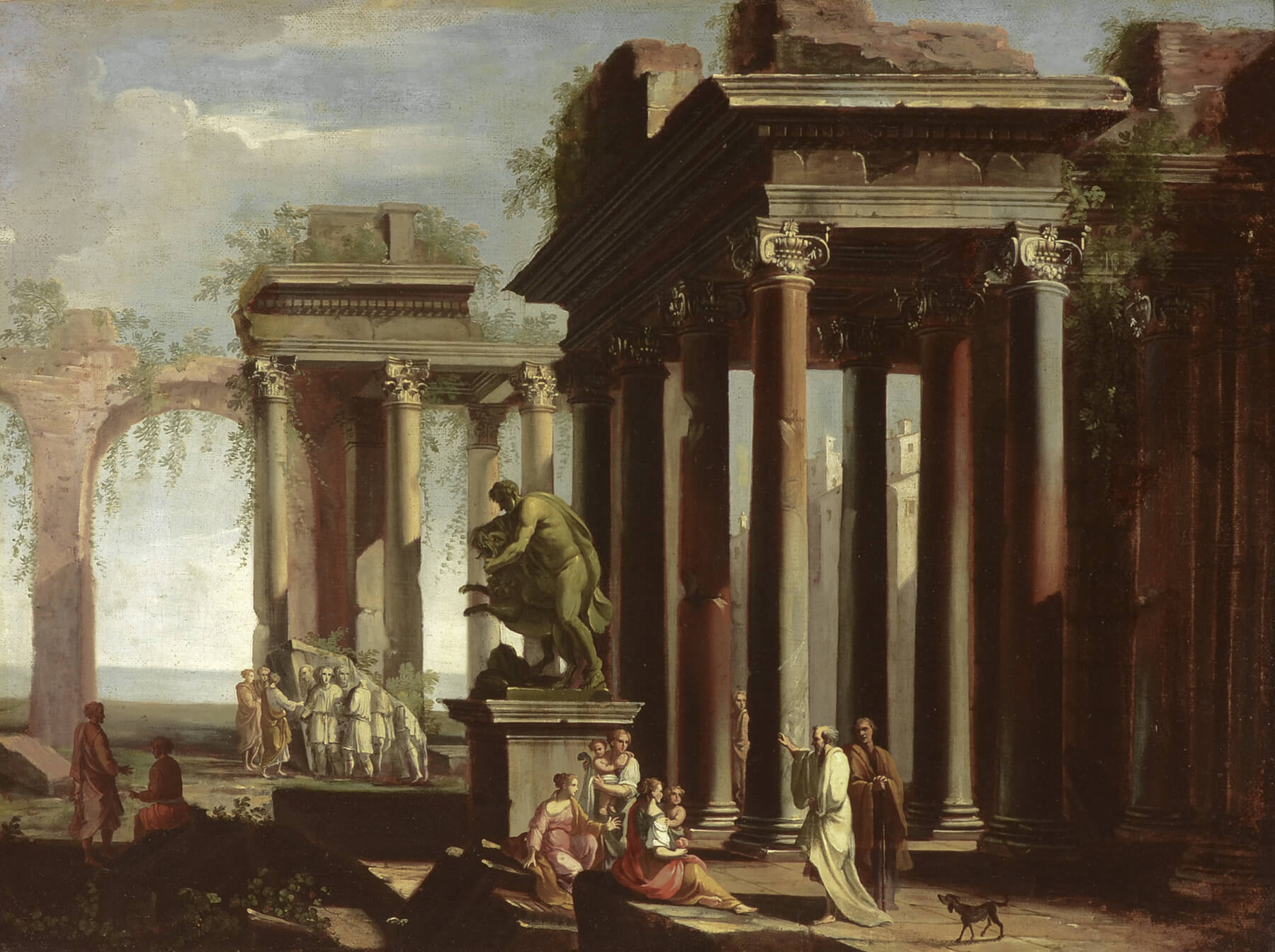
Alberto Carlieri
rome 1672 – after 1720
capriccio with an apostle preaching
47 x 63.5 cm., oil on canvas
Among the paradoxes of Art History is that many of the most significant artists are not especially well-known. The vagaries of fame are not inevitably aligned with talent, ability, intelligence, production.
“(Carlieri) emerges from oblivion or ignorance into a role as one of the dominating figures in the genre (of architectural painting) at the beginning of the 18th century”, writes historian David Marshall. Carlieri’s ‘dominating’ oeuvre is eclipsed in part by the fame both of the painter in whose studio he worked as a young man – Andrea Pozzo – and that of another younger artist who learned (and took) much from Carlieri’s example – Gian Paolo Panini – greatest of the Italian architectural painters of the 18th century.
Pozzo (Trento 1642 – 1709 Vienna) was the first and arguably greatest master of quadratura – architecturally illusionistic painting – very often carried out at the scale of cathedral domes and ceilings. His great ‘monuments’ are virtual – thrillingly dramatic architectural spaces rendered in trompe l’oiel. Gian Paolo Panini (Piacenza 1691 – 1765 Rome) absorbed Carlieri’s understanding of quadratura and architectural perspective, as well as his delicate, closely observed, subtly-colored and nuanced manner with ruins and groups of figures, then formed a more dynamically grand and grandiose style, picturing Rome’s ancient remains – an approach almost immediately successful, especially with the crowds of Grand Tourists then making their way to the Eternal City.
While Panini absorbed other influences, especially the work of the older Giovanni Ghisolfi, Carlieri is something of the crucial (though not quite missing) link between Pozzo’s high Baroque and Panini’s proto-Neoclassism. Though we may count it Carlieri’s bad luck to be sandwiched between more eminent painters, he was very highly regarded during his lifetime. “He paints beautiful pictures full of architecture, containing attractive stories with small figures, lively movement and fine colors, that are altogether delightful,” writes Pellegrini Orlandi in Abecedario Pittorico (1704).
The present painting, portraying an apostle and his audience, is a high example of Carlieri’s mature work, and is pictured in Marshall’s The Architectural Piece in 1700. “The Paintings of Alberto Carlieri (1672 – c. 1720), Pupil of Andrea Pozzo”, in Articles et Histoires, Vol. 25, No. 50 (2004). According to Marshall, another painting mentioned in the article may have originally been pendant to our picture. At this painting’s center is a monumental bronze sculpture of Hercules and the Nemean Lion, the subject of Jupiter’s son’s first labor. Towards the back of the picture’s space is a ruined stone relief, whose stone figures appear not very different from those humans standing nearby. The painting’s setting, like others by Carlieri, is alongside a more modern town, by the edge of the sea. Unlike other capriccio artists, Carlieri rendered his own figures, and these, like his architecture, are singular, often wrapped in robes, arms and hands expressive, eyes and other facial features rendered in deep shadow. A particular pleasure of this canvas is its remarkable state of preservation, whose surface is very largely unworn, and whose colors retain their original saturation.
Paintings by Carlieri are included in the collections of the Musee des Beaux-Arts, Nancy; Walters Art Museum, Baltimore; and Staatliche Kunsthalle, Karlsruhe; among others. This painting will is pictured in Giancarlo Sestieri’s 2015 Il Capriccio Architettonico.