Subscribe
to the piraneseum journal


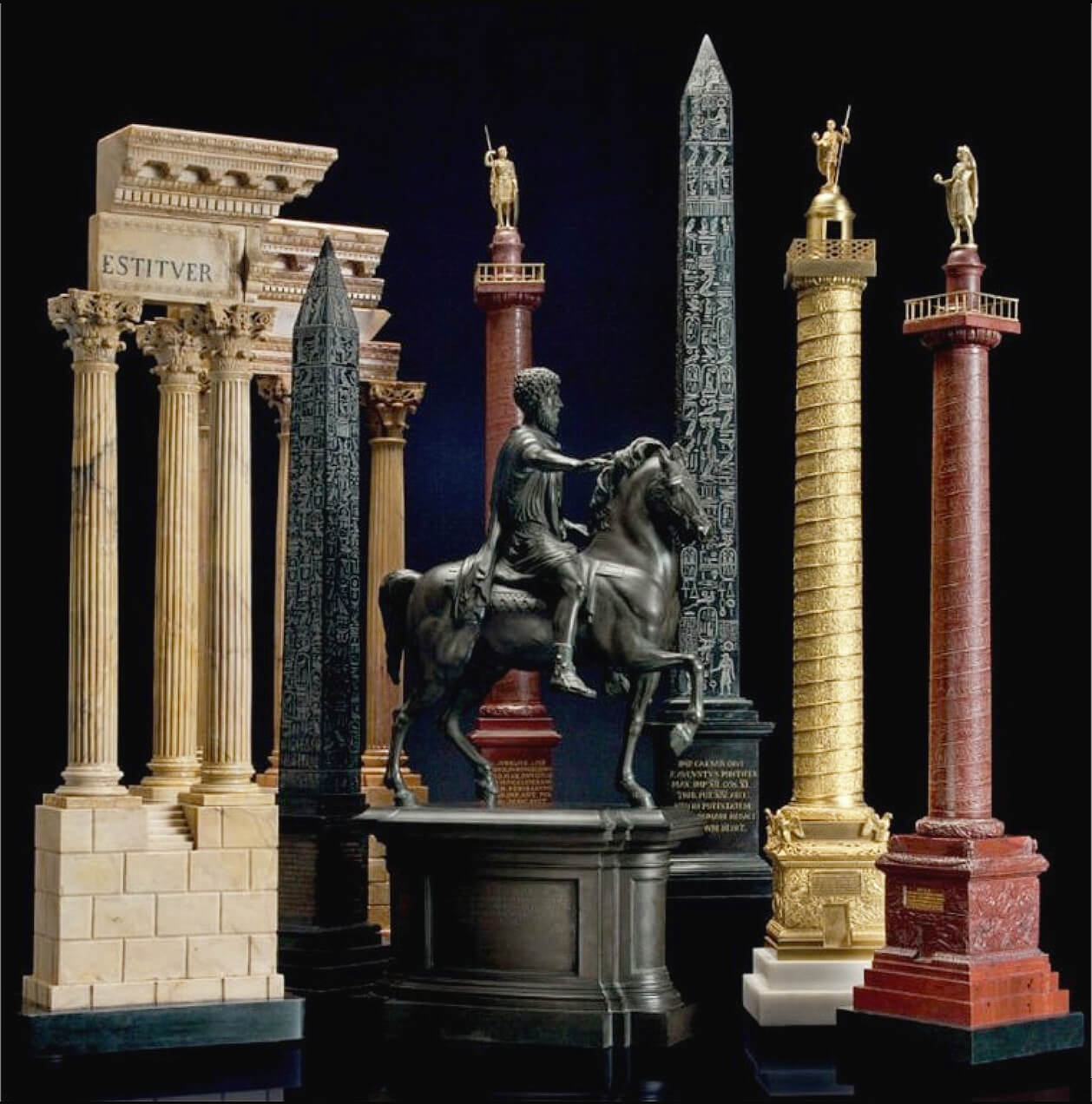
In the 90’s and early 00’s, Christie’s lead the way in making the market in Grand Tour souvenirs. For collectors, their annual sales were much anticipated and closely followed. Thus, it is a particularly resonant satisfaction to offer, with Christie’s, a group of especially grand, Grand Tour architectural models.
The Catalog for their October 23 sale in New York includes a richly-illustrated and described section – Lots 325 – 333, given to some of the best of Piraneseum’s 19th century models, including highly-realized examples in the range of antique marbles, as well as bronze and ormolu.
The Catalog may be seen here. Our section begins on page 208.
Additionally Christie’s provides a feature – Souvenirs from the Grand Tour – in which Specialist William Russell, Jr. “takes a look at the history of these superb souvenirs” by describing “five (Piraneseum provided) examples of important 18th and 19th century architectural models”. To see this feature, click here and scroll down to Souvenirs from the Grand Tour, which occurs just before Christie’s essay on Monet’s Water Lilies!
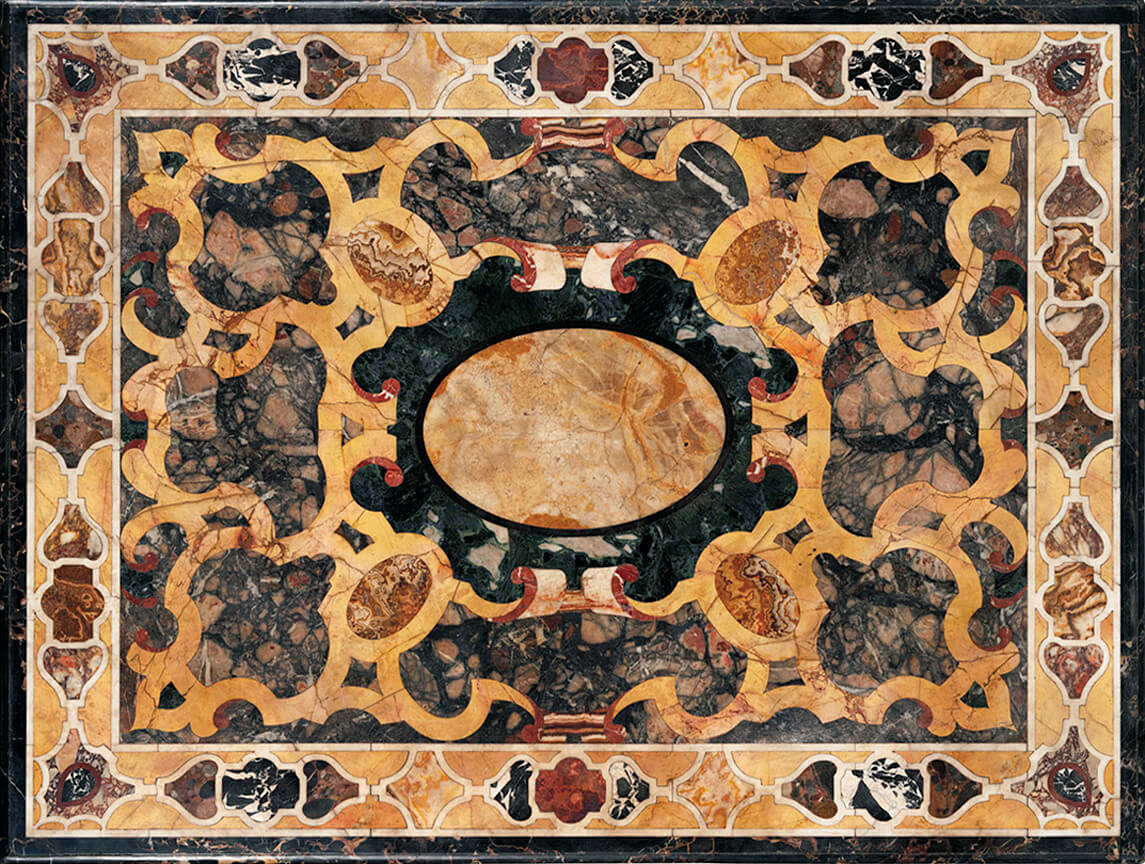
16th C inlaid marble table top, precursor to a very similar table top commissioned by Ferdinando 1 de Medici several years later.
Though focused on architectural mementos, occasionally our attention wanders. We are only human.
Several years ago, at a sale in Italy, we came across a very beautiful inlaid marble tabletop, apparently from the latter part of the sixteenth century. After the usual rigmarole involving export licenses, customs clearances, etc., it found its way here. Lucia was soon in touch with a leading authority, eventually visiting her in Florence, and translating her illuminating expertise.
Christie’s April 20th Exceptional Sale – the house’s leading Decorative Arts auction – includes just 27 lots. The last of these is James Bond’s very own Aston Martin. The first of these is Piraneseum’s mid-19th century remarkably exuberant, joyfully overwrought, carved marble oil lamp, a peak work by Benedetto Boschetti, il virtuoso eclettico e visionario. A link is here.
Lot 20 is our inlaid marble tabletop. Today, we received a link to its catalog entry.
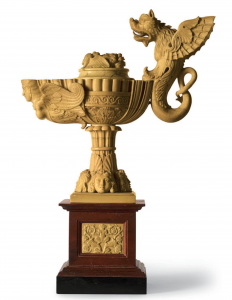
Highly detailed carved antique marble oil lamp by Benedetto Boschetti, Rome
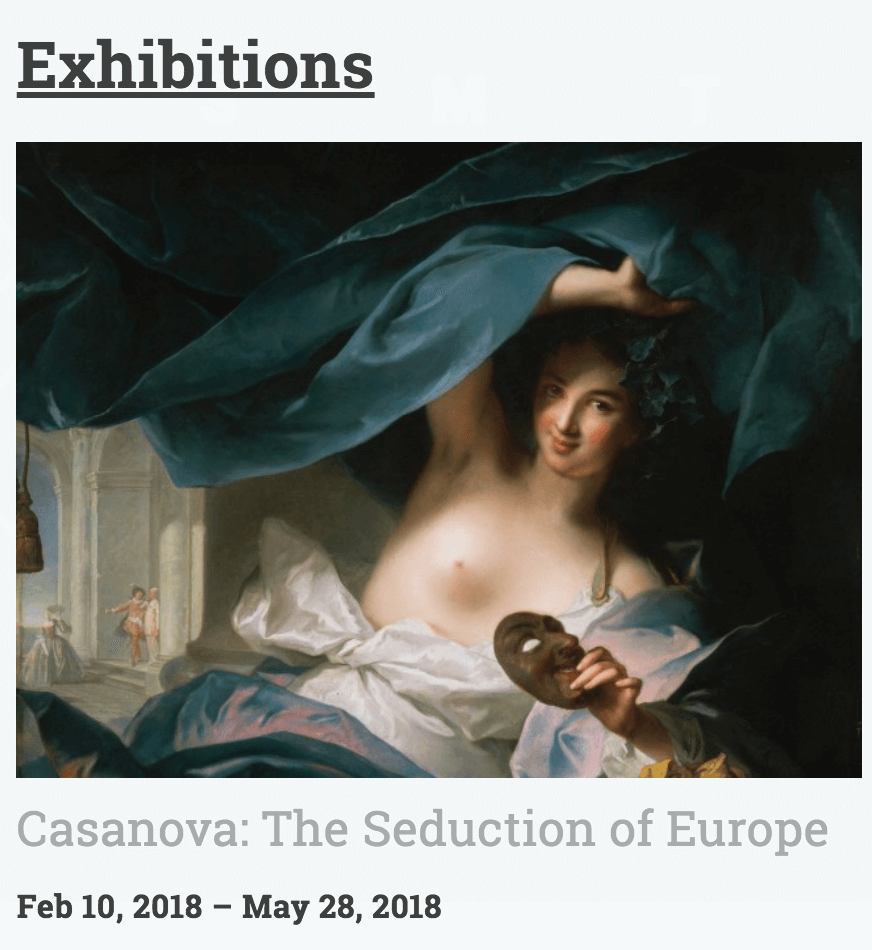
Casanova: The Seduction of Europe, at San Francisco’s Legion of Honor through May 28, 2018, is a remarkable installation conceived as a romp through 18th C. Venice, Paris, and London in the footsteps of Giacomo Casanova (Venice 1725 – 1798 Dux, Bohemia). A spectacular assemblage of paintings by Canaletto, Bernardo Belloto, Francesco Guardi, Francois Boucher, Jean-Honore Fragonard, William Hogarth, and many other artists of the period illustrate this sumptuous and colorful world. Casanova’s 13 volume autobiography, Histoire de ma vie, has been described both as “one of the most authentic sources of …European social life in the 18th C.” (Paul Zweig’s The Adventurer, 1974), and “a classic of erotic literature” (the online Art Directory). Casanova himself was a well educated intellectual, brilliant writer, scoundrel, hedonist of the first order – and a very popular dinner guest when not in prison or exile.
Though the large, engrossing and, in many instances jaw-dropping, pictures dominate, this exhibit marshals a collection of sumptuous furnishings and trappings, clothing and tableware, set within large black and white drawings illustrating the lavish interiors inhabited by these objects, to create an immersive experience following the narrative of Casanova’s adventures. After it closes at The Legion of Honor, the exhibit will move on to the Boston Museum of Fine Art (July 8 – October 8, 2018) with the somewhat drier title Casanova’s Europe: Art, Pleasure and Power in the 18th Century.
The Legion of Honor’s “Digital Story” accompanying the exhibit.
We much enjoyed Carol Porter’s docent lecture Taking the Grand Tour with Casanova on April 3. Don’t miss the Legion’s engaging and very informative “Digital Story”, narrated by Virginia Brilliant, the new Curator-in-Charge of European Art, a beautifully illustrated multimedia introduction which captures much of the exhibit’s complex and appealing story.
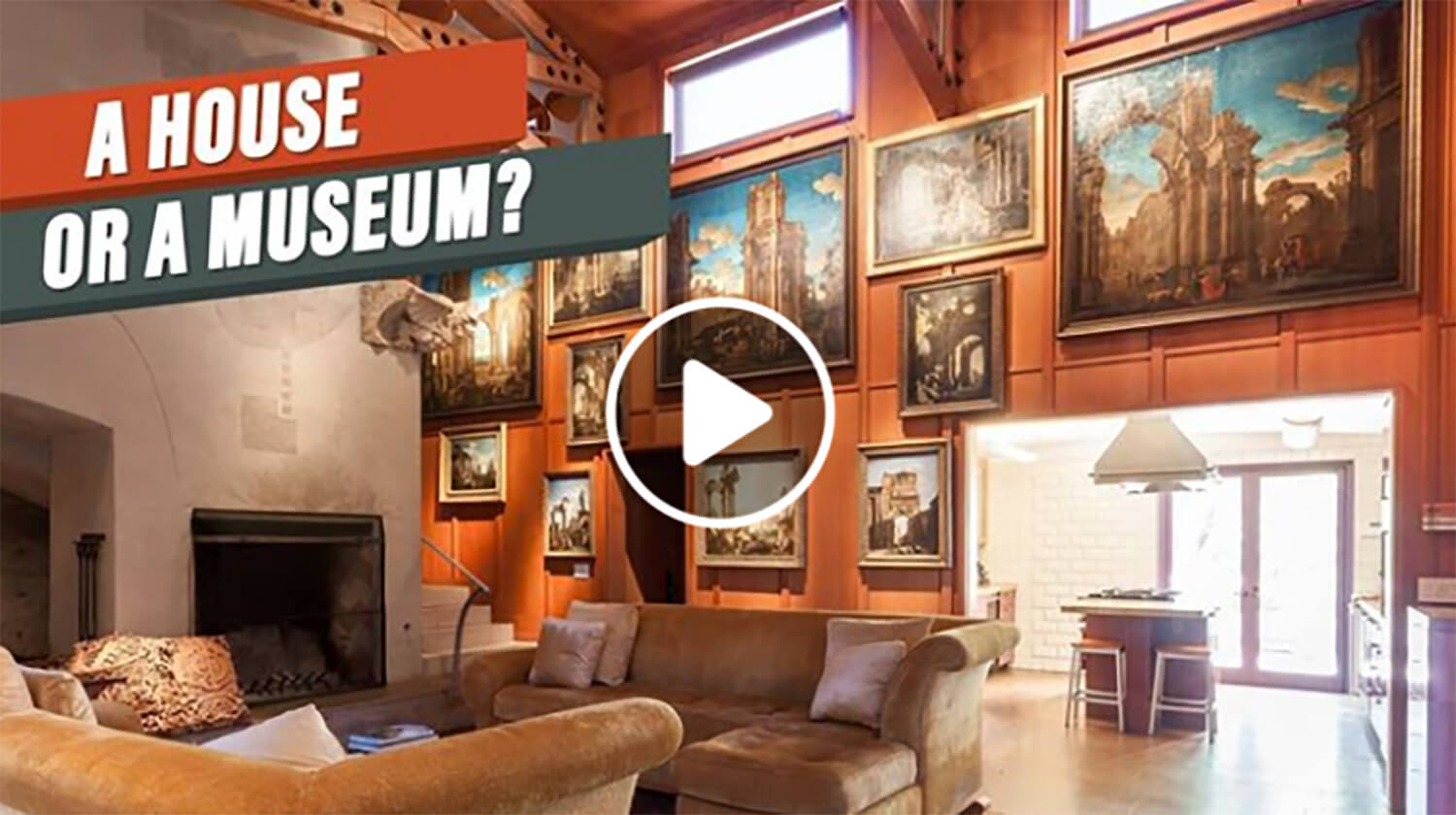
This Curbed.com video about Piraneseum nears half a million views.
Two years ago, Curbed, the multi-city Amercian blog featuring “all things home” posted A Pair of Architects Create a Home for their Grand Collection, an extensively-photographed, well-written description of our assemblage of 17th – 19th century architectural souvenirs.
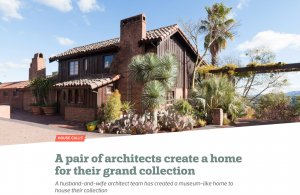
Curbed.com article about the collection from 2015
Late last year, Curbed was again in touch, proposing a short video about the collection. A day of shooting and later extensive editing yielded A House or a Museum?, seen, as of today, by over 478,000 people, liked by 2.9 thousand, shared by 1.2 thousand, with 246 comments – some formidable metrics for objects so long out of favor.
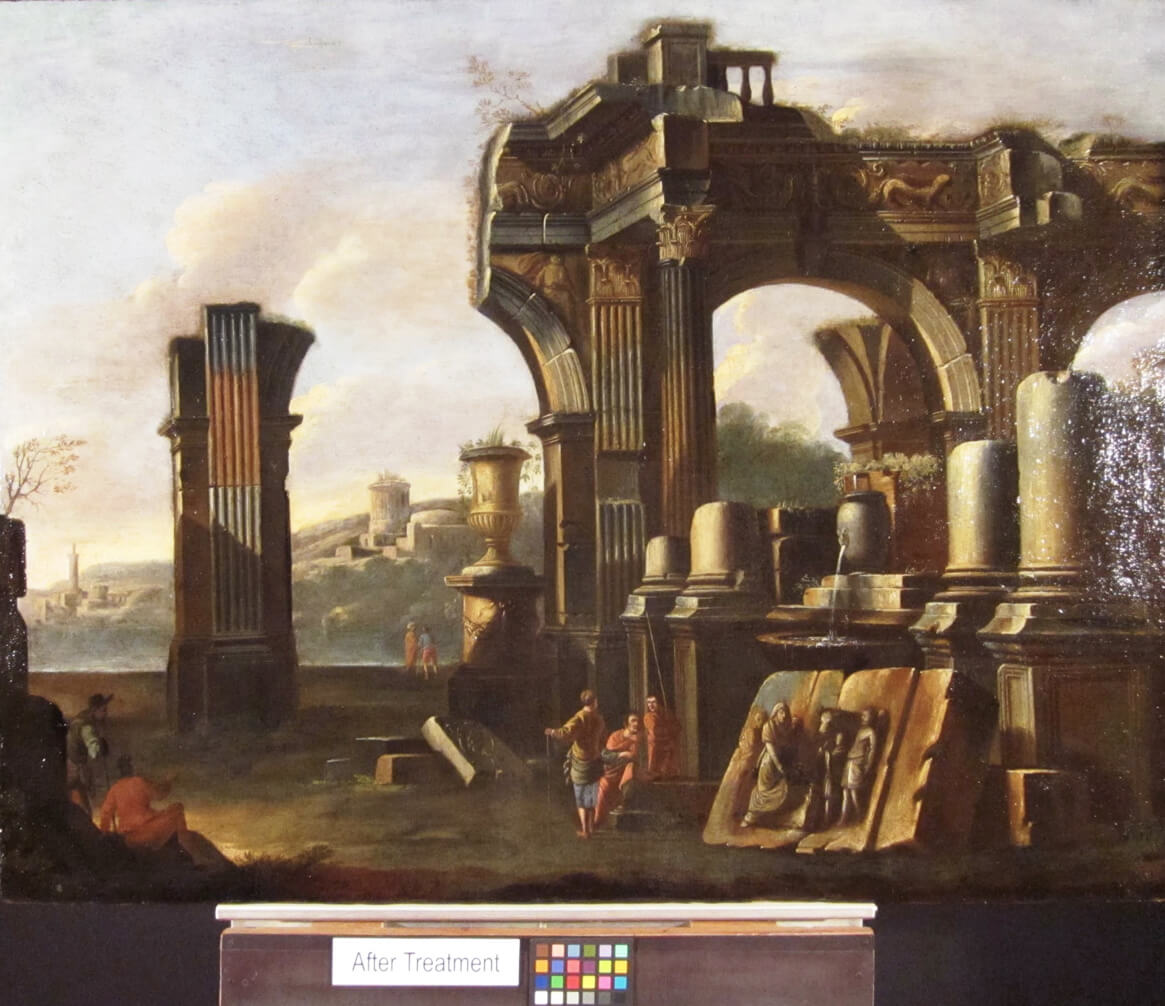
The Re-discovered Ghisolfi after careful restoration
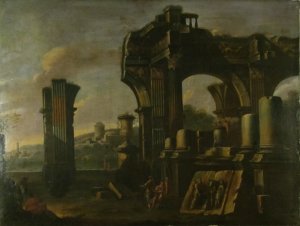
Figure 1. The Ghisolfi as we found it, prior to conservation
A year ago, in an out of the way German sale, we became intrigued with an old, darkened, architectural canvas. Peering through the cloudy, yellowed, cigar smoke-scented varnish, we thought we made out several elements characteristic of the later 17th century Roman ruins painter Giovanni Ghisolfi (Milan 1623 – 1683) (fig. 1). Telltale signs, in addition to the picture’s skewed perspective, included skillful light to dark shading of cylindrical column shafts, a complex decorative frieze, a diminutive spout of water into a semi-circular basin, as well as figures derived from Ghisolfi’s friend and occasional collaborator, the famed, occasionally infamous, Salvator Rosa.
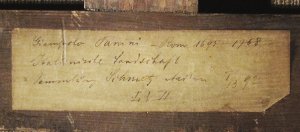
Figure 2. Label to the reverse side of the painting
Pulling in another direction was a handwritten label to the reverse, ascribing the work to “Giampolo Panini – Rome 1695 – 1768”; as well as noting a prior owner (fig. 2). Panini, of course, is today considered the great master of capriccio painting, and his pictures may realize significant sums at auction. In Art History, as elsewhere, things change; and in the 19th century, among some historians, Panini was counted little more than an imitator of, you guessed it, Ghisolfi. This likely accounts for the confusion with this picture’s authorship, something, as we’ll see, which continues today.
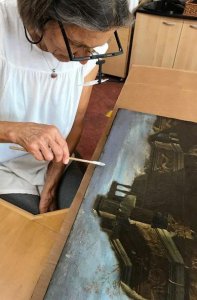
Figure 3. Pauline Mohr at work on the painting’s conservation. Note the spectacles, allowing her to view the surface under magnification.
It is safe to say that, without Ghisolfi, Panini’s work would have been very much different. The younger artist carefully studied (and selectively appropriated) the older man’s work; and there are extant Panini drawings copying Ghisolfi’s capricci.
Subsequent conservation has literally brought to light a picture fully characteristic of Ghisolfi (fig. 3). And while confident of this attribution, we were pleased to see a very similar painting in Andrea Busiri Vici’s 1992 Giovanni Ghisolfi: Un Pittore Milanese di Rovine Romane, titled by her Fantasia Architettonica Romana (fig. 4). Of this picture, now part of the collection of Denmark’s National Historic Museum, where it is attributed to the even earlier capriccio painter Viviano Codazzi, Vici writes “A mio parere l’opera potrebbe essere di Ghisolfi.” – In my opinion the work could be of Ghisolfi. We concur.
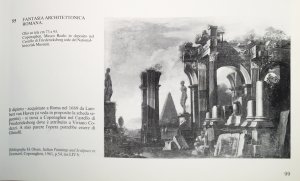
Figure 4. A very similar capriccio in the collection of the National Historic Museum, Copenhagen